

How Napoleon was defeated in 1812
(according to Leo Tolstoy).
(Jyly 21, 2025)
How Napoleon was defeated in 1812 (according to Leo Tolstoy).
(July 21, 2025)
If you read War and Peace (1869) by Lev (or Leo) Tolstoy, you may find messages customized for you depending on your socio-economic-cultural states.
When I read War and Peace for the first time, I had expected a heroic period adventure like Charles Dickens’ works. What I found bewildered me instead. In the story, there are full of beautiful people with ugly motives and ugly actions. These people are characterized by such adjectives as; greedy, calculating, idiotic, idle, spoiled, narcissistic, egoistical, weak-minded, sadistic, masochistic, cruel, etc. You can count all the Seven Sins in the story. Only Kutuzov, the commander-general of Russian army, is marginally respectable, logical, and consistent (because Tolstoy wanted to restore his honor). Now I’m a grown-up and old enough to understand the complexity of the world and human nature. Still, I cannot come up with a name in the story with whom I want to associate. I’d rather be an observer of these people.
Tolstoy was born in 1828. So, when he published War and Peace in 1869, Napoleon was a figure in history, had been sent to exile on Saint Helena, and died in 1821 at age 51. For the people con-temporary with Napoleon, he was a powerful, divine, and mythical figure. But Tolstoy, who was con-temporary with Charles Darwin (1809-1882), was able to analyze Napoleon and his wars with scientific views.
How and why Napoleon was defeated in 1812? Tolstoy is not explicit about factors which contributed the Napoleon’s defeat. On the other hand, with absolute confidence, Tolstoy lists elements which did not contribute. They are operations, strategies, and tactics designed on papers by high-rank officials in armchairs. (Kutuzov knew these theories won’t work in real battle fields.) The main reason for the plans being armchair theories is the communication difficulty among military units. At the time of Napoleon wars, the communications among military units were mostly carried by messengers on foot or on horseback. Suppose there are two military units. Then, the number of lines for communication between the units is one. (Maybe two for back-and-forth information transmission.) Figure 1A depicts the case. In the figure, two circles are military units (nodes), and a line connecting the nodes for communication. Likewise, three lines for three nodes, six lines for four nodes.
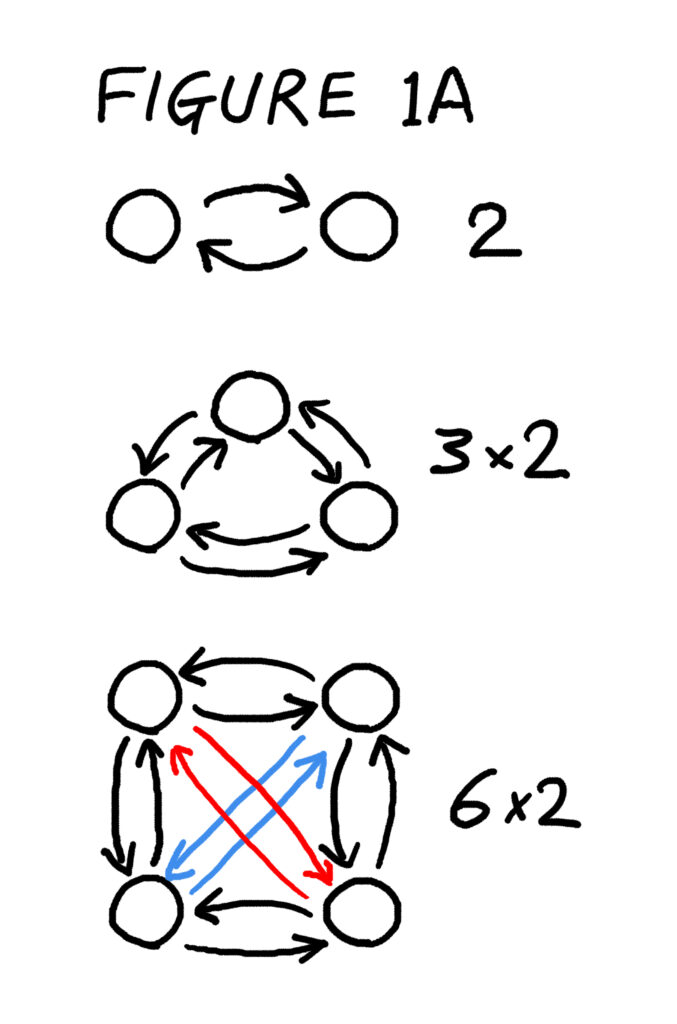
When there are 5 military units, the number of lines for communication is 10. (Figure 1B. It’s twenty if back-and-forth transmission is necessary.)
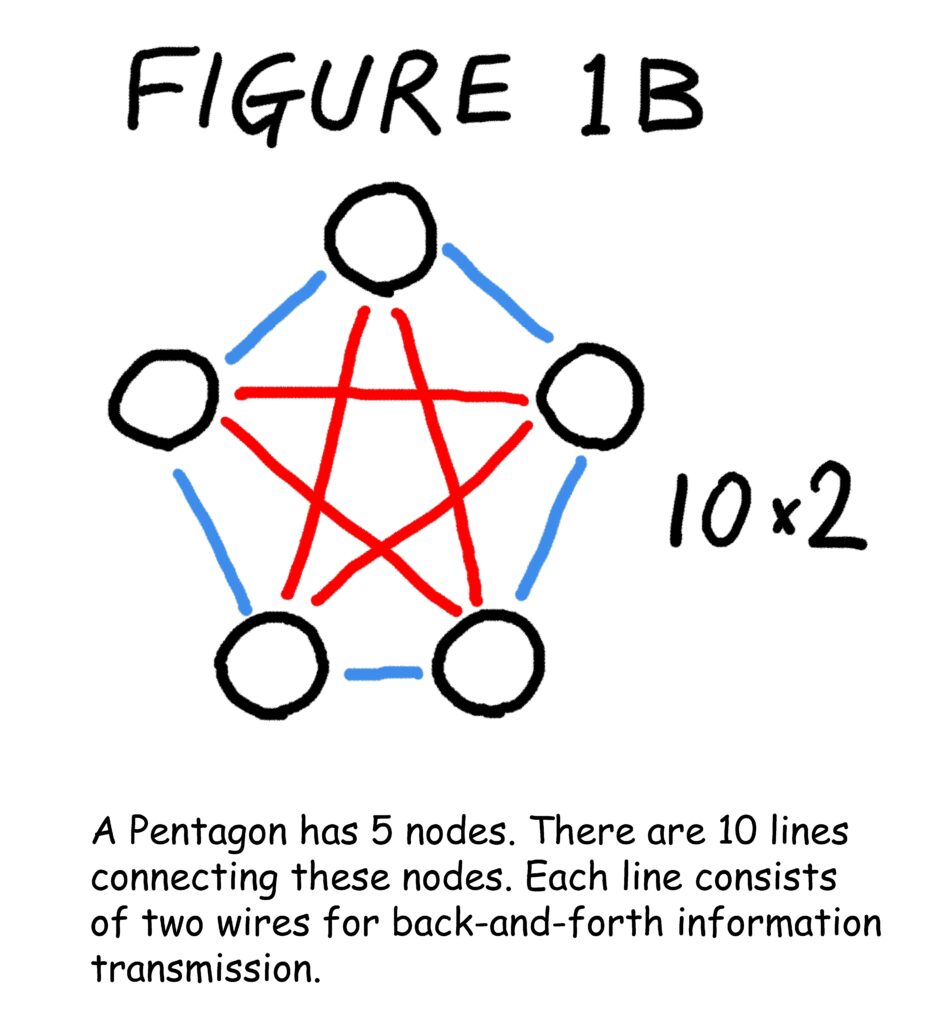
In general, the number of lines connecting each pair of nodes of a polygon with n nodes (n ≧ 2) is {n×(n – 1)}/2. The number of communication lines increases at exponential rate with the number of military units. (For more general cases with respect to the distribution of nodes (military units over battle fields), there are researches to find the most efficient route to transport information and logistics, in progress by scientists who study operations research.) The number of military units on both sides in 1812 Borodino must have been enormous. In addition, as the battle field spread wider, the distances among units got further away. These elements made instantaneous and accurate information sharing almost impossible.
So, what were the elements which defeated Napoleon and his army? According to Tolstoy, it’s the anger against invaders shared among Russian people. When the anger reaches and exceeds a critical level, people dare expose themselves against guns and cannons, and start to fight back. Compounded with tactical difficulties, Napoleon and his army might have felt it impossible to move beyond Moscow (which was burnt down and ransacked badly) into the territory filled with hostile people, soldiers and civilians alike, without appropriate logistics. The outcome was that Napoleon and his army started to retreat. The speed of the retreat rose at ever increasing rate, and the size of Napoleon’s army got smaller along the way. The survivors must run faster to get away from the hunters. According to Tolstoy, the main force of the hunters were partisan groups; Cossacks and serfs, who at the time were marginalized by socio-economic-cultural system, were especially angry against oppressors both internal and external, attacked and looted the retreating soldiers. When Napoleon reached French territory, the size of his army was reduced by 1/3.
Dear my friend. How did you read War and Peace? What messages did you find in the story?
Maybe, there are messages for the Napoleons of the 21st century.
(1) The information and communication systems are the most important elements, as important as the quantity and quality of arms, for the wars throughout human history. The military technologies, hard and soft, have been significantly improved compared to the 1812 level. Still, the message holds, even more than the past, in the 21st century. Those who control the information and communication have definite advantage. Nowadays in the sky, there are many orbital satellites for ICT users, commercial and military alike. These devices are owned and controlled by public organizations and private enterprises. For the Napoleons of the 21st century to gain advantages in the wars, domestic and abroad, it is crucial to seize the control of ITC system.
(2) Avoid kindling hate and animosity against you among your enemies and allies.
(3) {(1), (2)} may fail. In that case, beware of partisan activities, especially by those individuals and groups who are marginalized in socio-economic-cultural systems.
At the time of Napoleon, the world nations were organized in hierarchy-caste-class pyramid-like structure. In Figure 2A, on the top of the pyramid was Napoleonic France. The second row (maybe) consisted of other European states made into Napoleon’s cronies. The bottom of the pyramid consisted of colonized territories in Africa, Asia, and “New Worlds”.
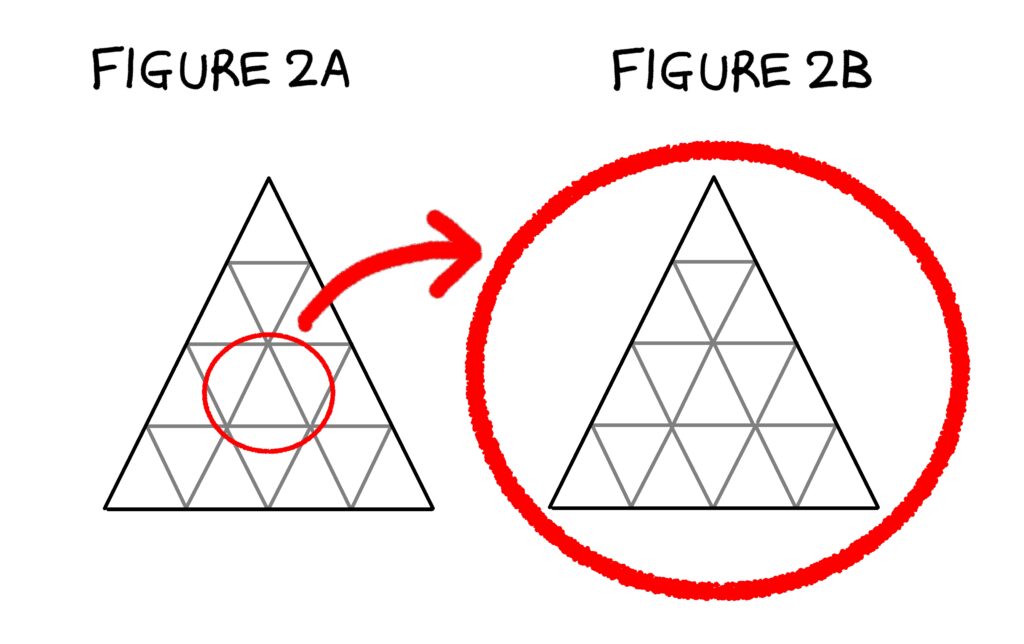
Suppose, you pick up a nation from the pyramid and look closer. (Figure 2B.) Maybe, you will find a similar hierarchy structure within the nation. (Such a convoluted structure is called a fractal.) Maybe, it’s in our genes. In any society consisting of more than two individuals, we form such hierarchy-caste-class structure. The structure may be stable, or unstable. But even if a pyramid collapses, we tend to rebuild a new pyramid. In War and Peace, Tolstoy shows how such a class structure was sustained, mainly through nuptial connections. Rich and famous and powerful people love each other. At the time of Napoleon, for an individual who belonged to a group near the bottom of pyramid, it was very difficult to rise up to higher classes. Maybe, this was the cost of socio-economic-cultural security and stability in the Napoleonic world.
In War and Peace, Tolstoy pense the human ethics; how an individual should be and how a society could be good? But, at the end of the book, Part II of Epilogue, Tolstoy expounds at length the analytical view of history as social science. (I don’t know if his view still holds in the 21st century.) Around the Tolstoy’s time, scientists directed themselves toward deconstructing objects into elements, as small as possible, which constitute the objects. The researchers in social sciences were also influenced by this trend. There is no sacred or divine figure in history. The actions of “great” people were interpreted as the outcomes of the sequences of events preceding the actions. (Philosophers question if there is such a thing as “free will”.) To Tolstoy, Napoleon is no exception.
Economics as social science also took this direction. The analysis starts with a concept known as “the law of demand and supply” in perfectly competitive market. The main actors are consumers (demand side) and producers (supply side). The number of consumers and the number of producers are large enough such that no single consumer or producer can affect price. Instead, each consumer takes price as given and decides the quantity of consumption (demand) at the given price level. Likewise, each producer takes price as given and decides the quantity of production (supply) at the given price level. Then, the market price is determined at the level such that the aggregate demand and the aggregate supply are equated. Economists also point out the problems caused by monopoly powers. For example, a producer that has large market share may control price in its favor by changing supply. Such activity may cause economic inefficiency. As examples in real life in recent years, well-known large ITC companies are prosecuted by some states in the US and some European countries, based on the possible violation of anti-monopoly laws.
With free will or not, can an action or a decision by a “great” individual, like Napoleon, change the course of history? Tolstoy is negative about the possibility. It is the people en mass that determine the course of history. Napoleon was just riding the trend. I am not sure about this view. Depending on situations, as action of an individual or an event may or may not change the course of history. Please let me clarify.
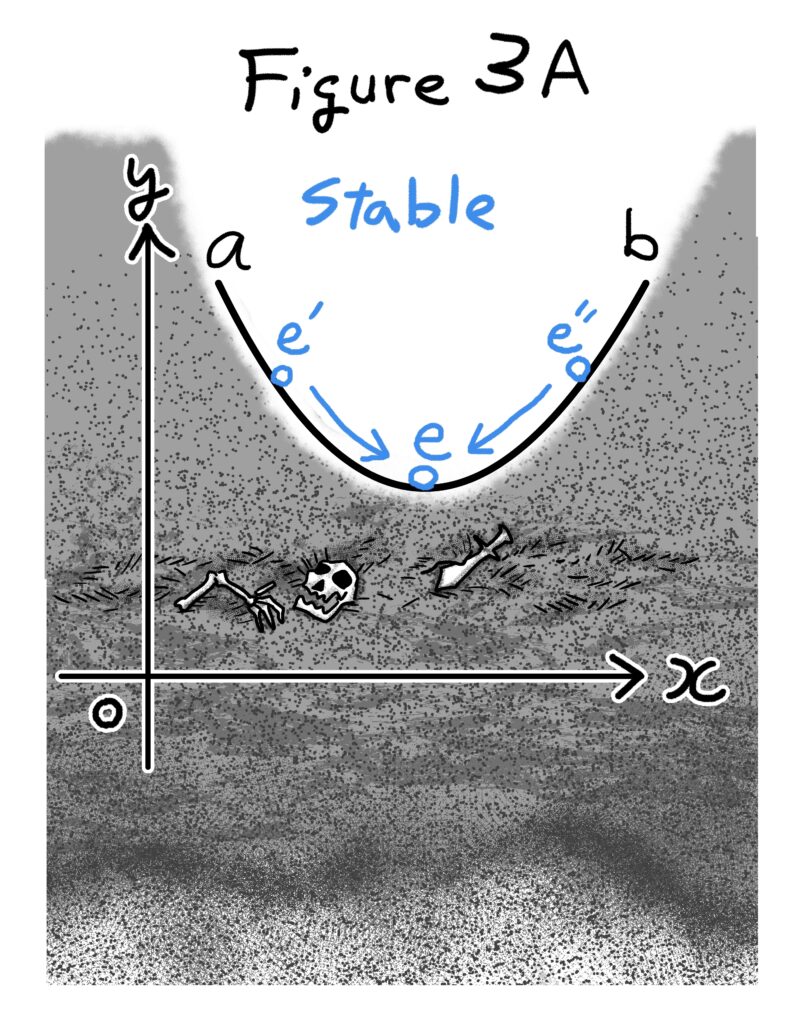
In Figure 3A, there are two metrics, x and y, which measure the states of a society. (I’m not sure what are appropriate measures to quantify the states of a society. Maybe, numbers such as income, asset, freedom, security, happiness, etc., can be used. Many public and private research organizations collect, calculate, and publish such numbers.) For example, x on the horizontal axis is the level of security, and y on the vertical axis is the level of freedom. When security(x) is high, freedom(y) may be low, and vice versa. In the figure, the curve labeled a-b depicts the possible combination of security(x) and freedom(y). The shape of the curve a-b may depend on socio-economic-cultural-technological fundamentals of the society. In Figure 3A, the U-shaped curve a-b implies that when security(x) is very small, freedom(y) is high. When x is very large y is also very large. When x is at intermediate level, y is low. Suppose initially, the state of the society is found at point e of a-b curve where the level of freedom (y) is low with the intermediate level of security (x). The U-shape of the curve a-b suggests that point e is “stable” because it sits at the bottom of valley. A shock to the society, which may be caused by an action of an individual or an event, may cause changes in the combination of security(x) and freedom(y) and push the society from e to e’ or to e” in Figure 3A. But in the long-run, the state of the society will return to point e. (In this sense, point e at the bottom of U-shaped line a-b, is called a stable steady state or a stable equilibrium.) In this view, even if Napoleon’s decisions affected the world, the world would return to the original course of history. (In Foundation and Empire (1952) by Isaac Asimov, a powerful and unexpected figure Mule causes the Galactic Empire (the Foundation) to deviate from the course of history. But Mule is defeated, and the Foundation returns to its original course of history which was prepared and predicted by a psychohistorian Hari Seldon.)
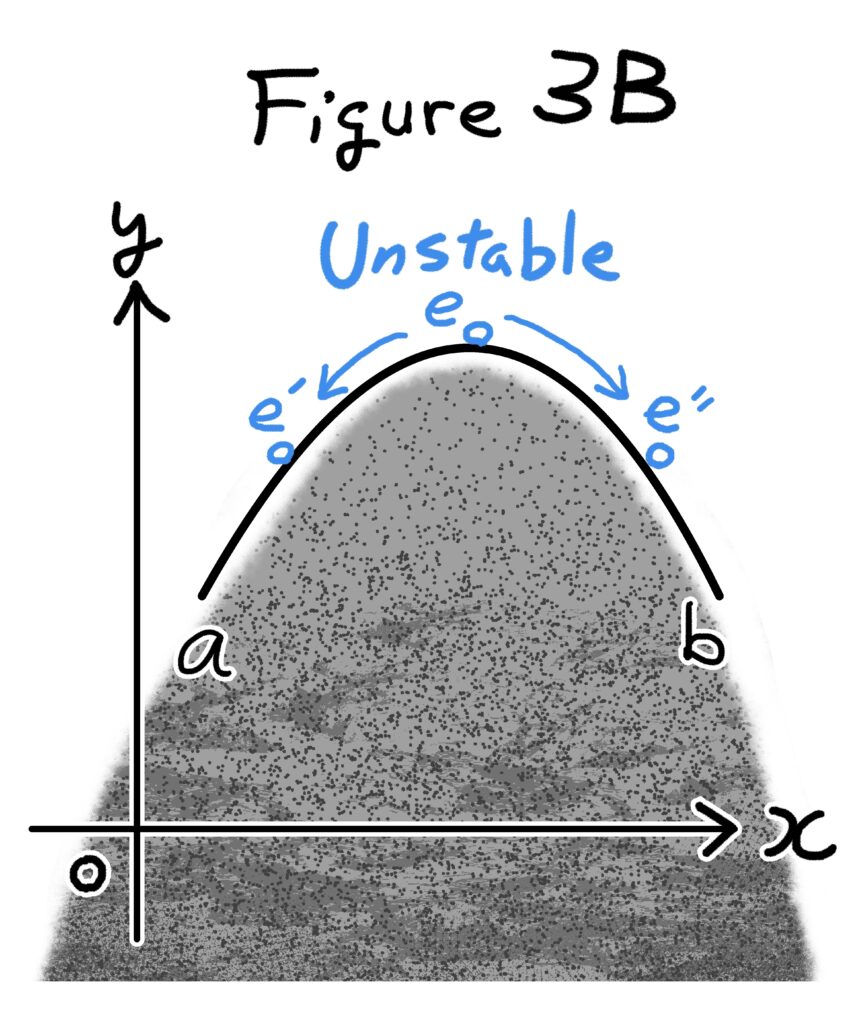
In Figure 3B, the curve a-b also expresses the possible combination of security(x) and freedom(y). But unlike the curve in Figure 3A, the curve in Figure 3B is inverse-U-shaped, like a hill. Suppose initially, the society is at e, the top of the hill. Then, a shock to the society may cause a downhill transition of society toward either direction, left (e’) or right (e”), depending on the nature of the shock. In this case, the steady state or the equilibrium point e is unstable.
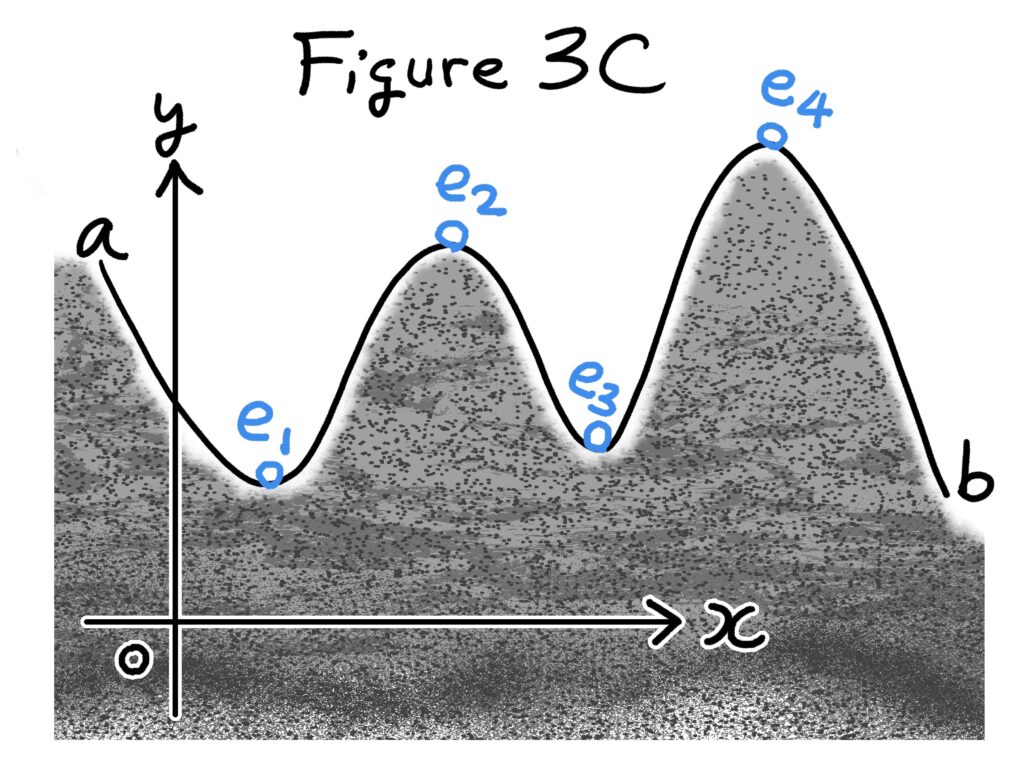
Figure 3C combines Figure 3A and Figure 3B. There are multiple stable steady states (e1, e3) and multiple unstable steady states (e2, e4). Suppose initially, the society is at e1. Small shocks may not affect the society in the long run. The state of the society will settle at e1. But large shocks may force the society to clime over the hills. In the long run, the society may find itself on a new state like e3. Along the transition process, notice that the society temporarily experiences and passes through the unstable state e2.
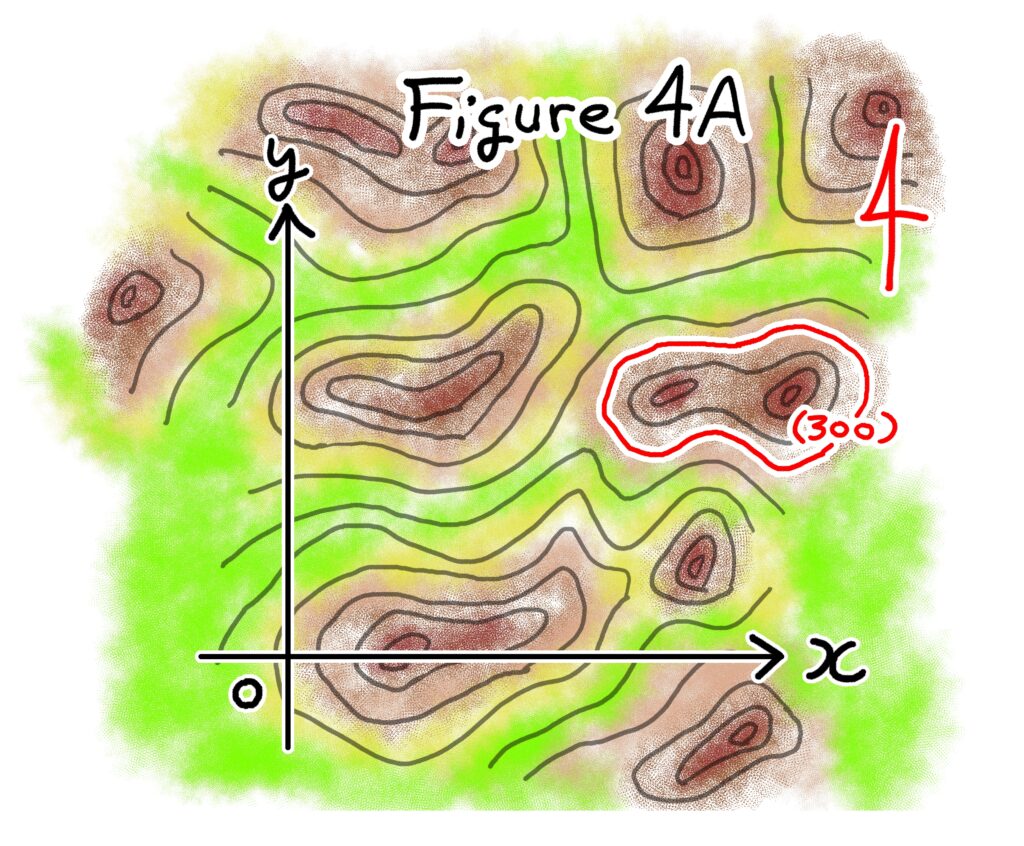
The above story can be expanded to higher dimensions. You may look at a topographical map of your territory to find hills and valleys. Figure 4A is a typical topographical map. The horizontal axis expresses east-west coordinate (x), and the vertical axis expresses north-south coordinate (y). In the figure, there are many lines, closed or open. They are “contours”. A contour is a line connecting all the points of a specified altitude. For example, in Figure 4A, a closed-red line is a contour for altitude 300 feet. Now, imagine that the three axes in Figure 4A are measures for the state of a society. The horizontal axis measures the level of security (x), the vertical axis measures the level of freedom (y), and the altitude measures the level of income (z). The shape of the 3-dimensional plane (geography) expresses all the possible combinations of security (x), freedom (y), and income (z) that are determined by the socio-economic-cultural-technological fundamentals of the society.
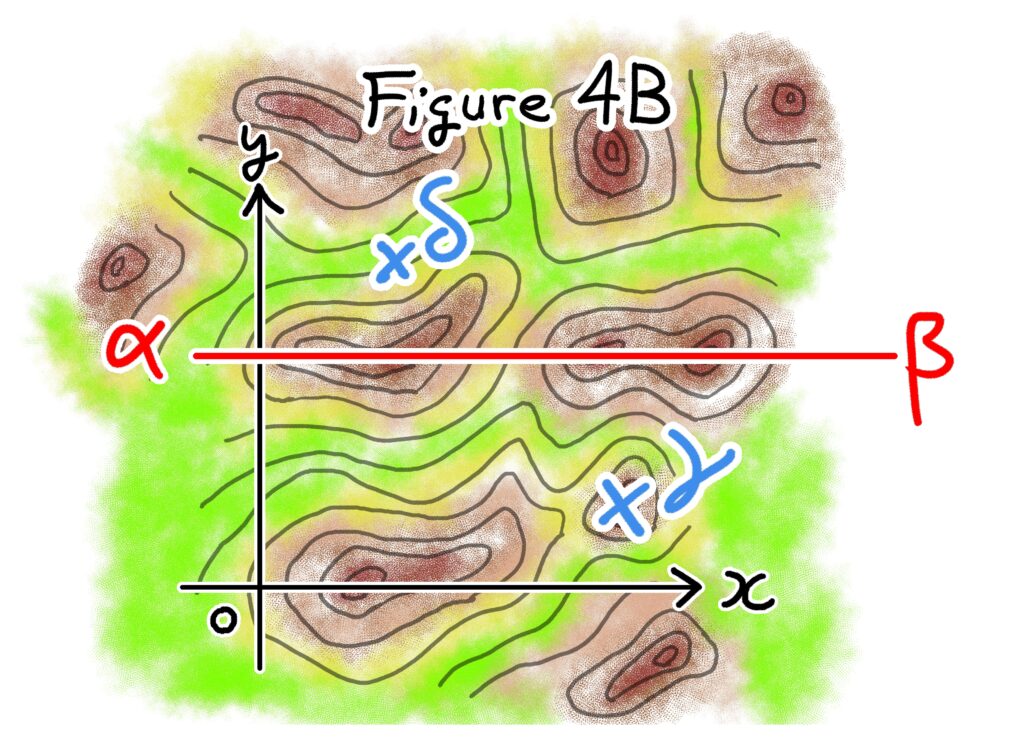
In Figure 4B, if we draw a straight line like α-β and cut the 3-dimensional geography along the line, like cutting a wedding cake, what we get at the cross-section is a curve like a-b in Figure 3C consisting of valleys and hills. The state of a society is expressed by a point on this 3-dimensional plane, like γ or δ. The location of a society may be determined by aggregate actions of consumers (demand side) and producers (supply side), and by socio-economic public policies. A society may enjoy high levels of security, freedom, and income. Another society may find itself in an opposite situation.
Although it is impossible to graphically extend the story to higher dimensions, we can express the state of a society with n-types of units of measurement as a point (x1, x2, … , xn), n ≧4, in n-dimensional space. An action of an individual or an event may affect the state of a society. Depending on the geographical shape of map, the state of a society may or may not be affected, for better of for worse, in the long run.
When looking back the past, people often say “shouda” or “coulda”. Of course, no one can change the past. So, the best we can do is not to repeat errors, and act wisely to make a better future. I wonder if Napoleon in Saint Helena was able to go back to 1812, what he would do.
Is there a co-called water-shed event? (If not for the event, world history could have been different.) If the big meteor missed the earth some 65-million years ago, the world we know now does not exist for sure. The Good Dinosaur (2015) depicts this possibility. It is said that the assassination of Archduke Franz Ferdinand in Sarajevo in 1914 triggered WWI. Tolstoy died in 1910 at age 82, so he did not observe the incident. But it’s likely that Tolstoy would be negative about the view; With or without the assassination, WWI would have been started. The Balkan area was already boiling at the time.
Anyway, there is no way telling about water-shed events. We can’t choose a history among possible alternatives. (Only in science fictions and fantasies.)
Dear my friend. Please tell me. If you can go back in time and change decisions you made, what would you do? Me? I issued idiotic words and took idiotic actions, which I want to undo but can’t, way too many. The memories haunt me. Maybe, I don’t want to go back in time in the first place.
References;
The Good Dinosaur (2015), produced by Denise Ream, directed by Peter Sohn, and distributed by Walt Disney Studios Motion Pictures.
Asimov, Isaac, Foundation and Empire (1952).
Tolstoy, Leo, War and Peace (1869).
