

A Room for Negotiation
(December 23, 2024)
A Room for Negotiation (December 23, 2024)
When I was little, I thought “Maybe, I can read people’s mind”. Maybe, I was inspired by comic books, cartoons, and science fictions. Of course, it was impossible, but I tried anyway. When someone approached me, I tried to imagine what was in his/her mind. Soon, I started to analyze people. When an individual takes a certain action, I imagined what was his/her motivation which induced the individual to act. The habit dies hard. At meetings or at parties, I try not to analyze people I meet so as not to be uncomfortable among strangers.
Maybe, an individual takes a certain action when benefit is larger than cost. In other words, people make decisions based on conscious/subconscious benefit/cost analysis. Obviously, not all the benefits and costs associated with a certain action are monetary. There are benefits and costs that cannot be measured in monetary units. And these benefits and costs vary among individuals, among groups of individuals, across societies, across cultures, and across time periods. Furthermore, it may not be a good idea to measure all the benefits and costs in monetary units. Such calculations might affect our system of inner ethics in irrevocable ways. We might be dealing with devils in such situations. (In Indecent Proposal (1993), a young married couple (Demi Moor and Woody Harrelson) is tried by a billionaire (Robert Redford). The billionaire is a devil. I still remember the SNL sketch based on the movie.)
In the previous post About Shogun and Jidaigeki (Nov. 19, 2024), I mentioned Sanada Hiroyuki’s motivation to produce realistic and authentic jidaigekis, but didn’t explain elements which make a jidaigeki to be realistic and authentic. One element which I think applies to many jidaigekis is the “clash within a civilization”. (The land of Japan consists of islands, and separated from continents by sea. In addition, Japanese leaders blocked international trades and communications for an extensive period of medieval to modern times.) When a clash or a conflict takes place within a civilization, the stakeholders may share ethnicity and/or culture so that there is a room for negotiation (although it may fail). Shogun (2024) is a story of a warlord rising among rivals to national ruling and unification. The unification is achieved through wars, but not all the wars are physical combats. Often, there are negotiations among warlords. They understand what are at stake, the benefits and costs of agreements or disagreements because they share ethnicity and/or culture.
On the other hand, when a clash takes place, not within, but between civilizations, it may be more difficult to find room for negotiations. Sometimes, the clash ends up in a situation in which there are two ultimate alternatives; to kill or to be killed. In Aliens (1986), there is no room for negotiation between the earthmen and the aliens. It’s either to kill or to be killed. On the other hand, in Predator 2 (1990), not in Predator (1987), we see a faint room for negotiation between the earthmen and the predators. Maybe, they have something in common which may lead to mutual understanding.
Starship Troopers (1997) is based on Robert A. Heinlein’s novel published in 1959. There is an episode which defines the relationship between the earthmen and the aliens. In a battle, the earthmen successfully captured an enemy alien. Upon the first close encounter, a young soldier Jonny, the main character of the novel, understands there is no room for negotiation. It’s to kill or to be killed. The director of the movie, Paul Verhoeven, who was born 1938 in the Netherlands, witnessed, experienced, and survived the Wars in Europe, depicted extreme violence of the wars between earthmen and the aliens. But I felt Verhoeven’s interpretation of Heinlein’s story was not clear. Did the director want to create a movie like All Quiet on the Western Front (1930), or Aliens (1986)? Maybe, there was a conflict between the director and the production company.
Ender’s Game (2013) is based on Orson Scott Card’s novel published in 1985. The novel is a bildung story of a young cadet Andrew Ender Wiggin. In the novel, the enemy aliens are, like Heinlein’s, depicted as non-negotiable objects to be destroyed for Ender’s initiation into adulthood. On the other hand, in the movie, in which Orson Scott Card also participated for production, the story ends with a hope for mutual understanding between the earthmen and the aliens. Maybe, there was a change in socio-political environment between the publication (1985) and the movie production (2013) which induced the creators to include the additional interpretation about the earthmen-aliens relationship.
Jidaigekis are Japanese period dramas. Of course, each country has its own period dramas. One of the well-known period dramas is Romance of the Three Kingdoms, written mainly by Luo Guanzhong in the 14th century, which is based on the historical events in the second-third centuries in China. China in those periods was divided into many territories. Each territory was ruled by local warlord and his clans. Among these territories, three were rising with desire to be a champion to unify China; Wei kingdom led by Cao Cao, Wu kingdom led by Sun Quan, and Shu kingdom led by Liu Bei. Although Wei was the strongest in terms of military resources, it could not overwhelm Wu and Shu combined. So, the formation of alliance between two out of three through negotiations was the central issue. In one episode, Wei and Shu formed an alliance to attack Wu. But after the war, Shu severed itself from Wei and allied with Wu because Wei became too strong and risky for Shu.
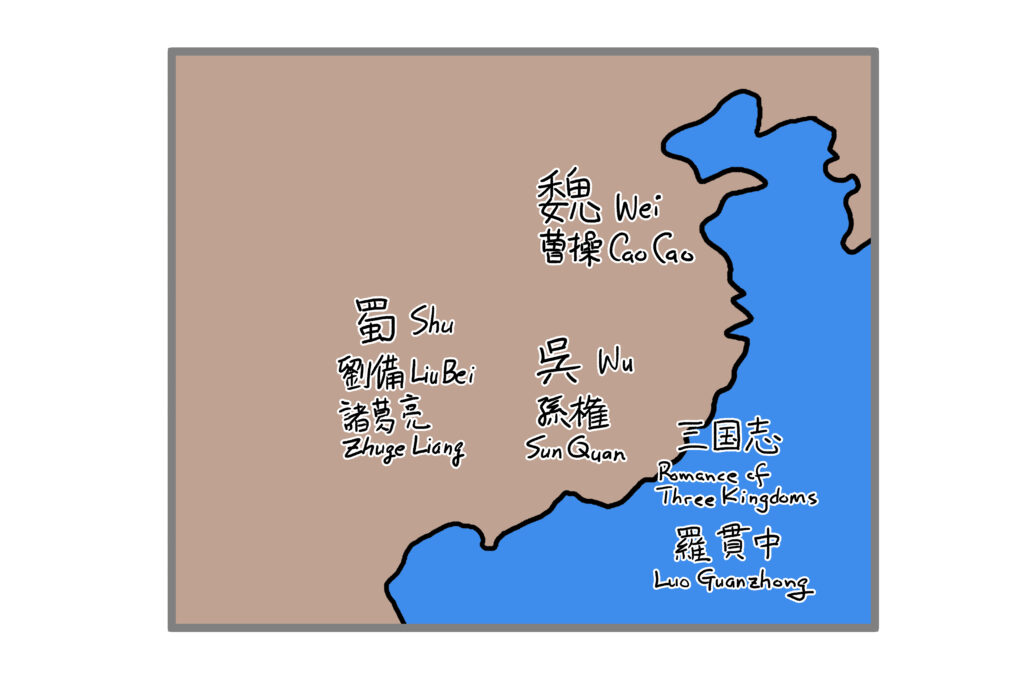
Romance of the Three Kingdoms consists of episodes telling alliances, betrayals, royalties, lies, and everything about wars, politics, and diplomacies. Cao Cao, the king of the most powerful Wei, is a calculating, cold-blooded man who does not hesitate lying to, betraying against, and double-crossing friends and allies if these actions are necessary for winning wars. Contrary to Cao Cao, Liu Bei, the king of Shu, is an honest and warm-hearted man who is royal to his ultimate goal of rebuilding the kingdom for Han people. Honesty sometimes is not a desirable character in the reality of intra/inter-regional policies and diplomacies. Without Zhuge Liang, the military commander of Shu, the kingdom could have been destroyed by Wei or Wu. Zhuge Liang conducts wars like games of chess. He reads many steps ahead of opponents, designs tactics and strategies, sets traps here and there into which the opponents inevitably fall. In the battle of Chibi (Red Cliffs), Zhuge Liang led allied forces of Wu and Shu to corner Wei one step away from total destruction.
Wars in any places and any time periods demand tremendous amounts of resources. In one episode, a wealthy merchant promised to support a local warlord. Although the merchant despises the warlord for his barbaric nature, he keeps the feeling inside because he thought that he can manipulate the warlord, and that the collaboration is profitable for his business. However, the honeymoon period turns out to be short. The difference in opinions gradually diverges, and leads to an inevitable end. I do not remember the fate of the merchant. Did he flee abroad? Was he captured, imprisoned, and executed? Please let me know if you remember the episode.
References;
Aliens (1986), produced by Twentieth Century Fox, written by James Cameron, David Giler, and Walter Hill, directed by James Cameron.
All Quiet on the Western Front (1930), produced by Carl Laemmle, directed by Lewis Milestone, based on the novel by Erich Maria Remarque, and distributed by Universal Pictures.
Ender’s Game (2013), produced by Gigi Pritzker, et. al., directed by Gavin Hood, based on the novel by Orson Scott Card, and distributed by Lionsgate.
Indecent Proposal (1993), produced by Sherry Lansing and Michael Tadross, directed by Adrian Lyne, and distributed by Paramount Pictures.
Predator (1987), produced by Lawrence Gordon, Joel silver, and John Davis, directed by John McTiernan, and distributed by 20th Century fox.
Predator 2 (1990), produced by Lawrence Gordon, Joel silver, and John Davis, directed by Stephen Hopkins, and distributed by 20th Century fox.
Shogun (2024), TV drama series, released from FX on Hulu and FX, based on the novel by James Clavell.
Starship Troopers (1997), produced by Alan Marshall and Jon Davison, directed by Paul Verhoeven, based on the novel by Robert A. Heinlein, and distributed by TriStar Pictures.
Card, Orson Scott, Ender’s Game (1985).
Heinlein, Robert A., Starship Troopers (1959).
Luo, Guanzhong, Romance of the Three Kingdoms, written in the 14th century. The story is translated in many languages and published in many countries.
